No Logo
10th Anniversary Edition
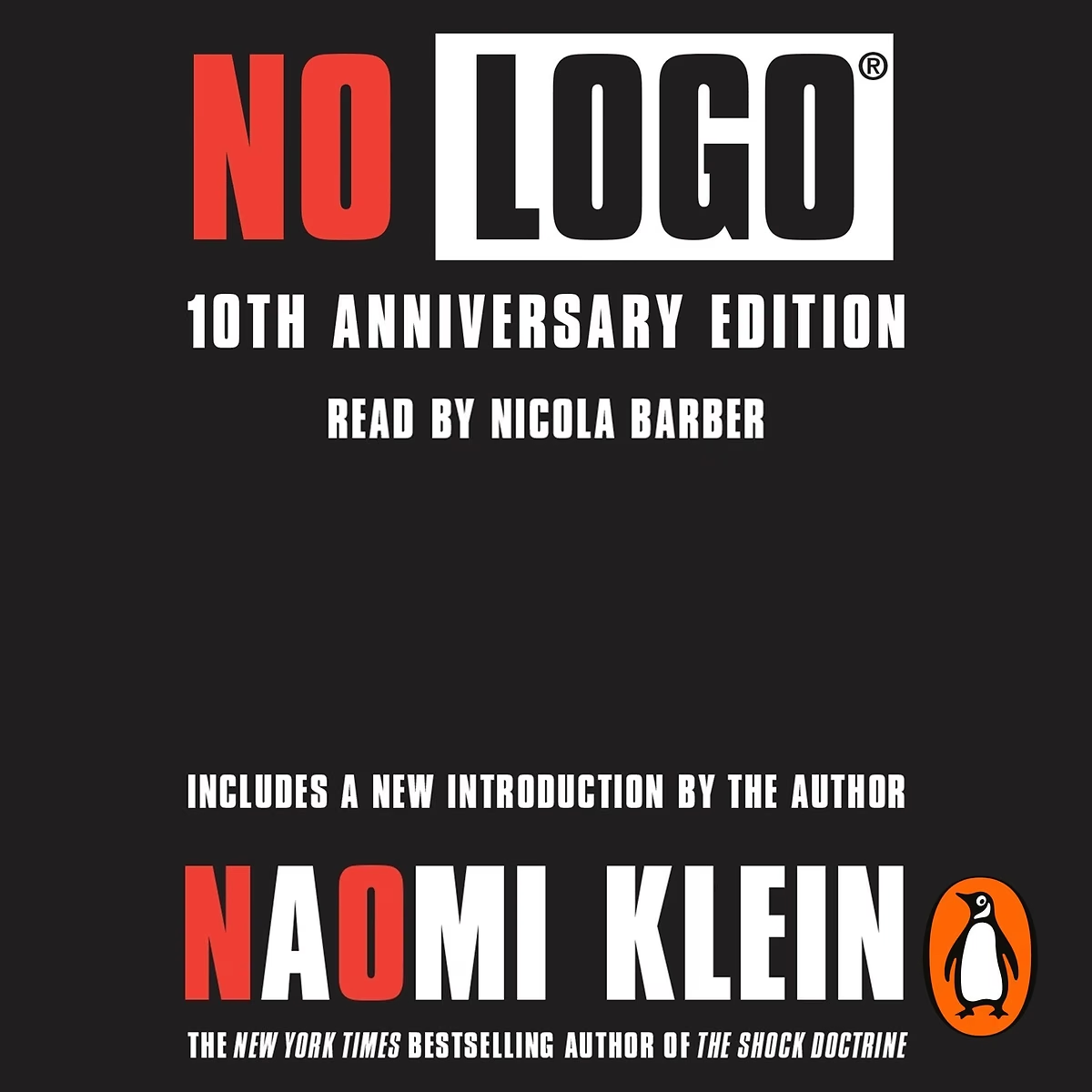
| Author | Naomi Klein |
|---|---|
| Year | 1999 |
| Original language | English |
| Narrator | Nicola Barber |
| Publisher | Penguin Random House |
| Format | audiobook (audible) |
| Edition | 2011 (originally the text 10th Anniversary Edition came out in 2009) |
| ASIN | B07F6HK6PV |
| Goodreads | View on Goodreads (opens in new tab) |
| Website | naomiklein.org (opens in new tab) |
| Rating | ★★★★☆ (4/5) |
No Logo came as a shock when it was published in the early 2000s. It came at what looked to be a uniquely troubled time, just after lots of people had been sold the idea that society could finally be stable and global crises were mostly a thing of the past. It was published shortly after the Seattle WTO protests and it gave a comprehensive explanation as to where all this unrest and disaffection came from. I can’t prove it (1)Well, and I don’t think I need to dedicate the energy and time to it – at least not yet –. Maybe one day I’ll write a history of the reactionary backlash to books like these, but it won’t be today. , but probably the reaction to some of the big named brands from the book helped publicise it, in a sort of Streisand effect.
Naomi Klein (2)Not to be confused with Naomi Wolf. By the way, another great recommendation (the linked book, not Ms Wolf). gave a brief history of the changes in marketing that corporations had been doing mostly through the 90s. Starting with Marlboro Friday, at the low point of the prestige of branding in the eyes of the people in the industry, and continuing through the great advances of the following years, she studies well how corporations managed to start selling “lifestyles”. She then does a quick run through the highlights of 90s capitalism.
In three lines, the gist of the book, except for the last part, is (3)The book used to have the slogan No Space, No Choice, No Jobs, which are also the big divisions in the book. :
- Corporations, in their push to sell us their brands, started occupying more and more of what had been, until then, untainted public space.
- They then used their power to crush competition and eliminate small, local businesses.
- All this while outsourcing increasing amounts of jobs to developing countries where employees are exploited.
Klein does go into detail and expands each of these points. For each of them she brings extensive research and social critique. Klein is a great journalist and writer. Not only does she defend her thesis well enough, but she also does it in a way that doesn’t sound clinical or preachy.
Writing this in 2026, in what I basically consider another step of global capitalism, the feeling is weird. On one side, a lot of it is like reading an old history book, because partly that’s what it is. Yes, the 90s were about 20 years ago (4)Live with it. . On the other, things are not better today, but corporations have been so successful, I feel, that we’re less actively conscious of these issues than we were briefly at the beginning of the 2000s. The invasion of public (and previously private) space has advanced even more, corporations are even more anticompetitive, and outsourcing and having products made by exploited people is something that is widely accepted. A book on the same topic written today, or even 5 years ago, would probably include a big part on more recent developments, but that doesn’t mean all of this is not still very relevant.
Anyway, what I’m trying to say is, if you want to understand the world we live in a bit better, do read this book. Or hear it (more on that just below). Of course this won’t give you the whole picture, but I don’t think there’s any book that will.
The 10th Anniversary Edition is, as far as I know, mostly the same as the original one. It includes an introduction by the author in which she comments on some developments from the 2000s. Brands are (were) more prevalent everywhere, to the point that some corporations tried to sell by using their brand less… as their brand. She also comments on how quickly and naturally the book itself became a brand in the world we live in. And finally, she comments on how branding also crept into American politics (5)All this reminded me how at some point, suddenly, everything in Spanish politics revolved around the “Marca España”, the “Spain brand”. The effects were certainly not as negative as in the American example, but I don’t think I have seen any good report or even commentary on how negatively it affected public discourse. .
I “read” it as an audiobook. It’s narrated by Nicola Barber, who does a pretty good job. Last year I heard Klein reading her own Doppelganger, something that I can’t but recommend (6)For the second time already in this review. , but Barber does a pretty good job too (7)Well, she’s apparently an award-winning, probably famous, voice actor, so very probably I’m not discovering a hidden gem. I can’t but agree with those awards, though. .
Categories: Non-fiction Tags: Publisher: Penguin Random House, Format: Audiobook, Naomi Klein, Nicola Barber, Literature in English, Politics, Economics, Business, Sociology, History, Marketing, Society, Political, Culture, Design, Philosophy, Capitalism, Consumerism, Activism, Format: Audiobook Rating: Rating: 4 stars